
Blogs
News & Updates
POST INFO
By Fast Ferrum | Business
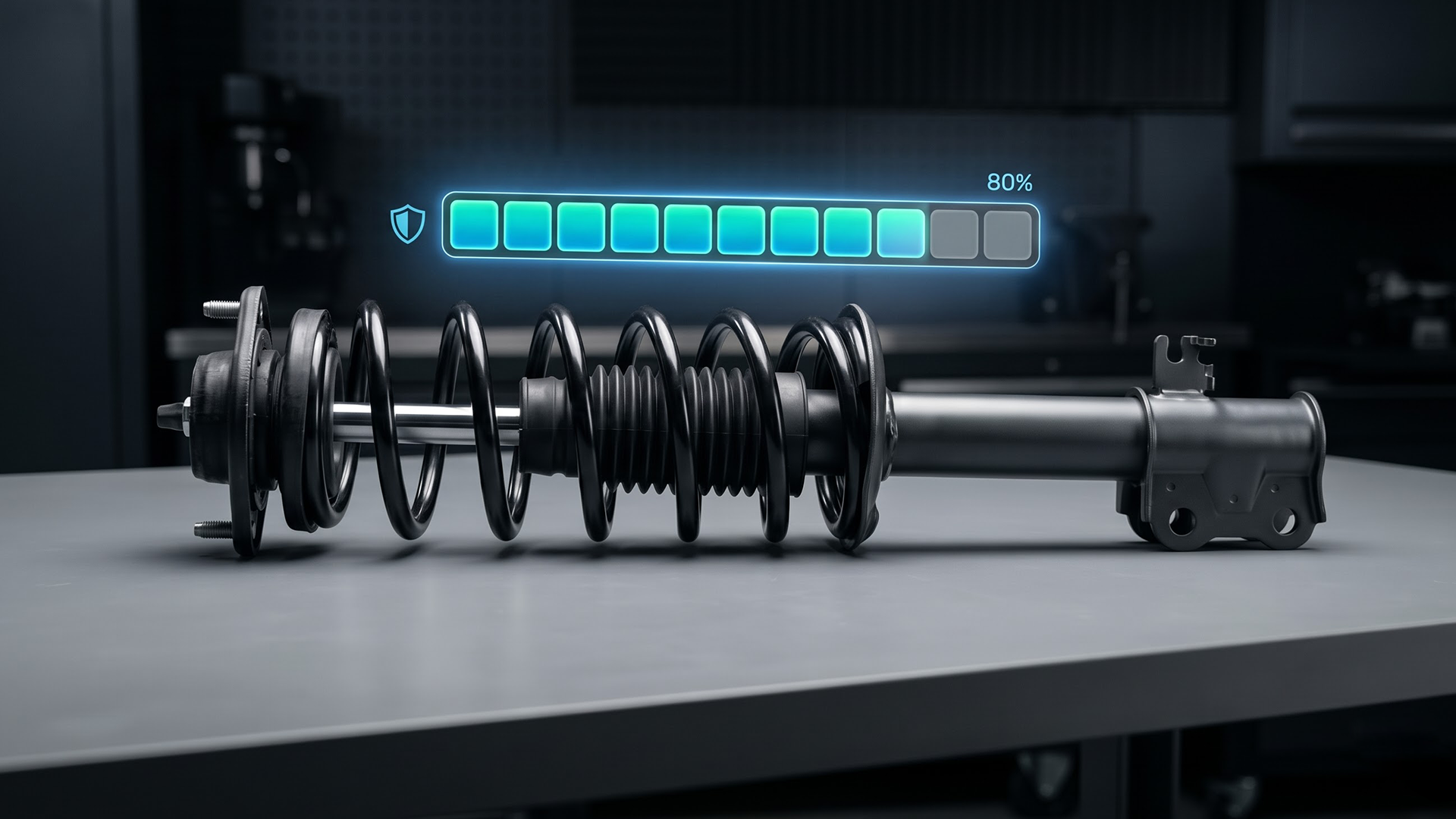
The Real Lifespan of Struts and Shocks: When Suspension Actually Needs Replacing
The number you see everywhere is 80,000 kilometres. Some sources say 100,000. It's a useful ballpark and it's also mostly wrong for how people actually drive in this country.
Struts and shocks don't wear out on a schedule. They wear out based on the load cycles they absorb. A car that spends its life on smooth highway in a mild climate can go 150,000 km on original dampers and still feel acceptable. A car that spends its winters navigating frost heaves on the 401, or its summers on gravel roads north of the city, can be gone by 70,000. The lifespan isn't the mileage. It's the abuse.
Here's the harder problem. Struts and shocks degrade gradually. You don't wake up one morning to a broken suspension. You wake up one morning to a suspension that's been getting worse for two years, and you've adapted to it without noticing. That's why most drivers replace dampers far too late. The comfort loss creeps in slowly enough that your brain adjusts, and by the time you finally do the swap and drive on fresh struts, you realize how far gone the old ones were.
The signs that actually matter, in the order they usually appear:
- The car takes an extra bounce after a speed bump. A healthy damper stops the body motion in one clean recovery. A tired one lets the body oscillate once or twice more before settling. You can test this in your driveway. Push down hard on a corner of the car and let go. If it bounces more than once and a half after release, that damper is worn.
- Nose dive under braking becomes more pronounced. If your car dips deep at the front when you brake hard, and the dip has been getting worse over time, the front struts are losing their control over compression damping. The car feels front-heavy and unstable during panic stops, which is exactly the scenario where you need the suspension to be at its best.
- Body roll in corners feels sloppier than it used to. This one is subtle because you adapt to it slowly. If you find yourself slowing down more than you used to for the same familiar corners, your dampers may be the reason.
- Uneven tire wear, specifically a cupping or scalloping pattern on the tread. When a damper can't keep the tire in consistent contact with the road, the tire bounces microscopically, and you get a wear pattern that looks like scoops taken out of the tread. This is often the first hard evidence that a damper is done, and by the time you see it, you've been driving on bad suspension for a while and you'll likely need new tires as well.
- Visible fluid on the strut or shock body. Dampers are sealed hydraulic units. If you see wet, oily residue running down the body, the seal is gone. Replace it. A damper without fluid is a spring with a tube around it, and it does nothing to control the wheel.
Canadian factors that shorten the numbers.
Freeze-thaw cycles crack road surfaces into the pothole networks we all know. Every pothole strike is a spike load on the damper. Salt corrodes the strut body and eventually attacks the seal from the outside. Gravel roads, if you're rural, deliver constant small-frequency work that heats the damper oil and breaks it down faster. Cold starts on winter mornings put stiffened fluid through valves designed for a warmer operating range, which accelerates internal wear.
If your driving includes any of the above, mentally cut the manufacturer's suggested lifespan by a third. A car that would have gone 100,000 km on paper is probably ready at 65,000 or 70,000 in real Canadian use.
Replace as pairs.
Fronts together, rears together. A fresh damper on one corner and a worn one on the other creates a car that handles unpredictably in emergency maneuvers, which is exactly when you need it to be predictable. Same principle as brakes.
Don't forget the mounts and bushings.
The strut mount at the top and the bushings at the bottom control points wear alongside the damper. On a car with 100,000 km or more, plan on replacing them at the same time. New struts on tired mounts will make noise and feel wrong, and you'll be pulling the front end apart again in a year to do the job you should have done the first time. Loaded strut assemblies that come with the mount, spring, and boot already assembled save time and take the guesswork out of it.
Get an alignment after the job.
Any strut replacement on the front axle disturbs the geometry. Driving on a fresh strut with old alignment settings will chew a new tire in one season. Budget the alignment cost into the job from the start, not as an afterthought. And use a spring compressor rated for the job if you're reusing springs. This is one of the few DIY jobs where the wrong tool actually can hurt you.
While the wheel is off.
Suspension work is the ideal moment to inspect the brake and hub components you can't reach any other time. Pad thickness, rotor edge condition, caliper slide pin movement, and hub bearing play are all right there in front of you. If any of them are marginal, this is when to address them, not on a separate weekend three months from now. Fresh brakes and a solid hub on top of new dampers give you a suspension corner that behaves the way it should. The Fast Ferrum brake and hub catalogue covers most common Canadian vehicles.
Post
Should You Replace Brake Rotors and Pads Together? A Straight Answer
02 FEB 2026
The Real Lifespan of Struts and Shocks: When Suspension Actually Needs Replacing
02 FEB 2026

That Humming Sound at Highway Speed? Your Wheel Hub Is Warning You
02 FEB 2026
5 Symptoms of a Failing Brake Caliper (And Why Replacement Beats Rebuild)
02 FEB 2026
5 Warning Signs Your Brakes Are Failing
02 FEB 2026