
Blogs
News & Updates
POST INFO
By Fast Ferrum | Business
Should You Replace Brake Rotors and Pads Together? A Straight Answer
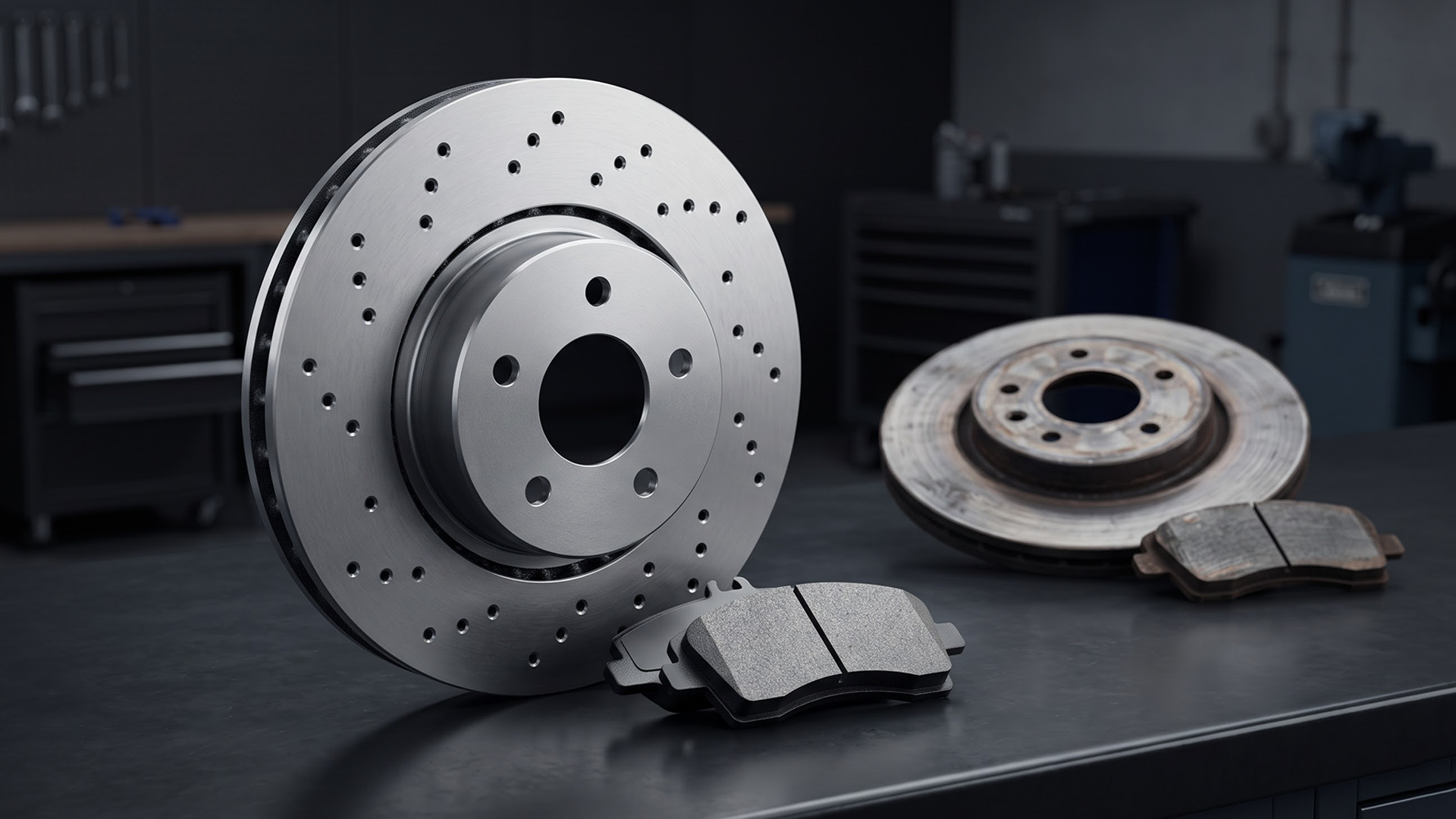
You go in for a pad change and the quote comes back with rotors too. It feels like an upsell. Sometimes it is. Most of the time it isn't. Here's how to tell the difference before you spend the money.
The short version: on a Canadian daily driver past its first pad change, you should almost always replace rotors and pads together. Here's why.
New pads bed into whatever surface is already on the rotor. If your old rotor has scoring, hot spots, or an uneven wear pattern from the previous set of pads, your new pads will conform to that damaged surface within the first few hundred kilometres. That means noise, vibration, and a shorter service life on a pad set that should have lasted you three or four winters. You paid for good pads and got the wear pattern of the old ones.
The second issue is thickness. Every rotor has a minimum thickness spec, usually stamped on the hub or edge of the rotor itself. In Canada, most rotors don't fail because they wore below spec. They fail because road salt eats them from the outside in. You can have a rotor that measures within spec on the friction surface but has heavy pitting and edge lift from corrosion. Slapping new pads on that is throwing money at a problem you'll be back to fix next spring.
When you can genuinely get away with pads only:
- The rotors are on their first set of pads
- Surface is smooth, no visible scoring you can catch with a fingernail
- No blue or gold heat discoloration
- Thickness measured with a digital caliper at multiple points and well above the minimum spec
- No rust ridging around the outer or inner edge
- The rotor has a coated finish that has held up on the non-friction surfaces
If all six are true, run new pads on the existing rotors and bed them in properly. That means about ten moderate stops from 60 km/h down to roughly 15 km/h without coming to a complete halt, followed by a fifteen minute cool-down drive with light brake use. Skip this step and you'll set up your new pads for the same uneven wear you were trying to avoid.
When rotors have to come off:
- Any visible cracks, even hairline
- Runout you can feel as pedal pulsation under braking
- Thickness at or near the minimum spec
- Heavy corrosion pitting on the friction surface
- Second or third pad change on the same rotors
- Hub mounting surface behind the rotor caked with rust and scale (you have to clean it back to bare metal anyway, and while you're there, replacing the rotor is the smart move)
One more thing worth knowing. Brake work happens as axle pairs. If your left front rotor is toast, the right one is coming with it. Braking is a balance system, and running one fresh rotor against one worn rotor gives you uneven bite and a car that pulls under hard stops. Same rule for pads. Same rule for calipers if it comes to that.
On rotor quality.
Not all rotors are the same, and this is where the Canadian environment matters more than most drivers realize. A bare cast iron rotor from a bargain box will start showing rust within days of installation. That rust doesn't just look bad. It transfers to the pad surface, creates uneven bedding, and starts the corrosion cycle over from day one. OE-grade rotors with proper coatings and heat treatment resist that first-season rust and hold their friction surface geometry through repeated heat cycles. On a winter driver, that difference shows up as fewer complaints and a longer service life.
Cost reality.
A good set of matched rotors and brake pads on a common vehicle runs less than doing pads now and rotors in eight months when the new pads have already been ruined. You're also looking at a second round of labour, whether that's your Saturday or a shop's time, a second parts order, and another round of bedding-in. Do it once, do it right.
Before you order parts.
Measure your current rotors with a digital caliper. Write down the reading. Compare it to the minimum thickness stamped on the rotor itself. If you're within a millimetre of the minimum, you're planning a rotor replacement, not deciding on one. And check both sides of the car. It's common to find one side worn significantly more than the other, which is itself a diagnostic clue pointing to a caliper issue you should sort out before installing anything new. When you're ready to order, the Fast Ferrum rotor lineup is engineered for exactly the Canadian conditions described above.
Post
Should You Replace Brake Rotors and Pads Together? A Straight Answer
02 FEB 2026
The Real Lifespan of Struts and Shocks: When Suspension Actually Needs Replacing
02 FEB 2026

That Humming Sound at Highway Speed? Your Wheel Hub Is Warning You
02 FEB 2026
5 Symptoms of a Failing Brake Caliper (And Why Replacement Beats Rebuild)
02 FEB 2026
5 Warning Signs Your Brakes Are Failing
02 FEB 2026